

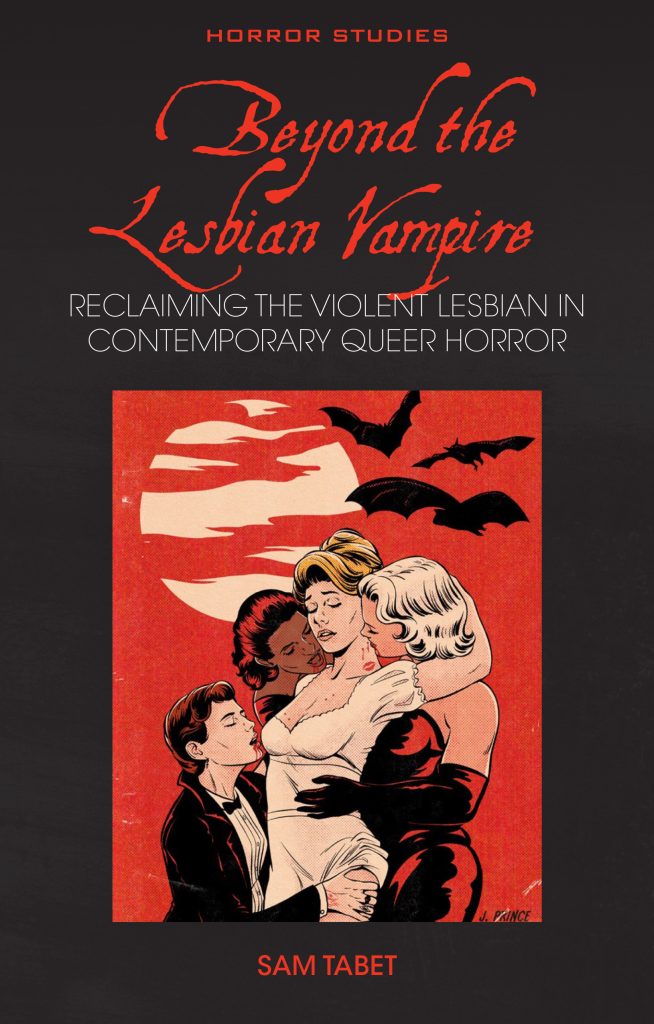
Sam Tabet introduces Beyond the Lesbian Vampire: Reclaiming the Violent Lesbian in Contemporary Queer Horror, now available in paperback.
The dismally reviewed Ryan Murphy show Monster: The Lizzie Borden Story was released on Netflix around the same time as the paperback version of my book, Beyond the Lesbian Vampire: Reclaiming the Violent Lesbian in Contemporary Queer Horror. The series is the second to explicitly portray Lizzie Borden as a lesbian since the 2018 film Lizzie with Kristen Stewart and Chloë Sevigny, and creates a fictional parallel between Lizzie Borden, Elizabeth Báthory and Aileen Wuornos, despite their lack of historical connection. Borden’s lover Bridget ‘Maggie’ Sullivan reads the tale of Countess Báthory aloud in their moments alone, seemingly stoking Borden’s lust for blood and depicting her as a big fan of one of the primary lineages of the lesbian vampire. The layering continues as the show moves to the 1990s where Wuornos is presented as an overzealous fan of Borden, despite no existing evidence of the sort. The spectator is asked to suspend their disbelief and accept that Wuornos, a working-class lesbian sex worker who was repeatedly raped by men, could be enamored with Borden, a wealthy woman in the late 1800s who allegedly got away with murdering her abusive parents.
The depiction of Wuornos as a ‘fan’ of Borden adds to a slate of recent works which self-consciously reference the cinematic and cultural fascination with tethering lesbian desire to violence. In Beyond the Lesbian Vampire the relationship between these ‘monsters’, Báthory, Wuornos and Borden, are clarified, not in their fictional obsession with each other, but rather through the sensationalism of women’s violence and the frequent presumption of lesbianism as an explanation for it. The ramifications of this in history and cinema are highlighted throughout the book.
I began my research after some time in the film industry exploring the impact of how homophobia and fictional narratives influenced real people and cases. My experience producing the feature documentary film Southwest of Salem: The Story of the San Antonio Four highlighted how film and media narratives about lesbians made their way into the court room. It was disturbing to witness the ease with which a jury believed that a group of young Latina lesbians in Texas babysitting one of their nieces was a satanic cult who gang-raped young girls. The validity of the legal arguments in court during the Satanic Panic relied on beliefs from the jurors and judges that lesbians were innately predatory, violent and likely to be satanic. These discourses borrowed from the narratives of witches and vampires seen in fictional horror films and hark back to films from the 1920s. Our documentary team worked with the Innocence Project of Texas to unpack these court room narratives when arguing for the innocence of the four women known as the San Antonio Four. The film aided in the exoneration of the San Antonio Four in November of 2016 and was cited in the legal documentation.
As a horror film fan myself, it was the research conducted during filming which politicized me to further investigate representations of violent lesbians in cinema, particularly of recent films that came out during the late 2010s. During my time touring with Southwest of Salem in 2016, The Neon Demon premiered at Cannes featuring a necrophiliac cannibalistic lesbian who was heavily influenced by lesbian vampire Báthory mythology. I started noticing violent lesbian characters in critically acclaimed horror of a similar look over the next three years. It was both the increase of violent lesbian representation and the shift of scholarly debates around queer horror which drew me to this research.
As the first monograph tracking the lineage of the violent lesbian in cinema, Beyond the Lesbian Vampire combines textual analysis with legal history and closely engages with seven core texts to explore the figure’s resurgence in queer horror; The Neon Demon (2016), Thelma (2017), Good Manners (2017), The Perfection (2019), Knife + Heart (2018), What Keeps You Alive (2018), and aforementioned Lizzie (2018). Extending from scholarly debates around lesbianism’s queerness and queer horror fears around assimilation, Beyond the Lesbian Vampire investigates and identifies the violent lesbians’ representational shifts and contemporary cultural salience. Each case study depicts multidimensional lesbian characters which trend toward more justifiable narrative reasons for violence while referencing and celebrating past iterations of this archetypal figure’s ‘innate’ desire for violence, particularly that of the lesbian vampire. This combination of excessive citation alongside contemporary narrative shifts allows for reclamation of the violent lesbian figure within queer horror. Beyond the Lesbian Vampire unapologetically foregrounds the lesbian in queer horror and explores how the films allow the lesbian monster to return to the silver screen, with complex desire, sexual agency and justifiable rage.
Sam Tabet is an independent scholar and award-winning filmmaker, whose work expands LGBTQ+ visibility and disrupts binary presumptions around gender and sexuality.